It defines the search area
Within the APE, the agency must make a reasonable and good-faith effort to identify historic properties that may be affected.

An analysis of 96 energy projects and the scope of their preservation review areas
Under Section 106 of the National Historic Preservation Act (NHPA), every federally permitted project gets a historic preservation review. The Area of Potential Effects, or APE, sets the scope of this review. Within the APE the agency must evaluate impacts on historic properties — including on views from such properties. There is no standard APE size, and projects can receive wildly different zones to evaluate.
We examined nearly 100 recent energy projects and found a striking discrepancy: compared to fossil energy projects, clean energy and transmission projects have review areas about 10 times larger and are more than 8 times as likely to receive an “adverse effect” finding — triggering additional process, delay, and mitigation obligations.
Median miles from project
Indirect or Visual APE: The area where a project could affect a historic property's views, sound, atmosphere, or setting without physically touching it.
Median acres
Direct APE: The land where construction or operation could physically disturb or alter a historic property.
Percent of projects in dataset
Adverse effect: A finding that a project could diminish the characteristics that make a historic property eligible for the National Register.
Reforming NHPA to right-size the APE is a clean energy win by helping clean energy and transmission projects get built faster.
Some adverse effects are physical: demolition, or alteration of the property itself. But the regulations also count the “visual, atmospheric, or audible elements” — a structure on the horizon, dust or reflections from a site, the noise of nearby operations — as adverse as well.
The example below is purely visual. The Lava Ridge turbines would stand miles from the Minidoka National Historic Site and never physically disturb it, but their appearance on the horizon was enough, on its own, for an adverse-effect finding.
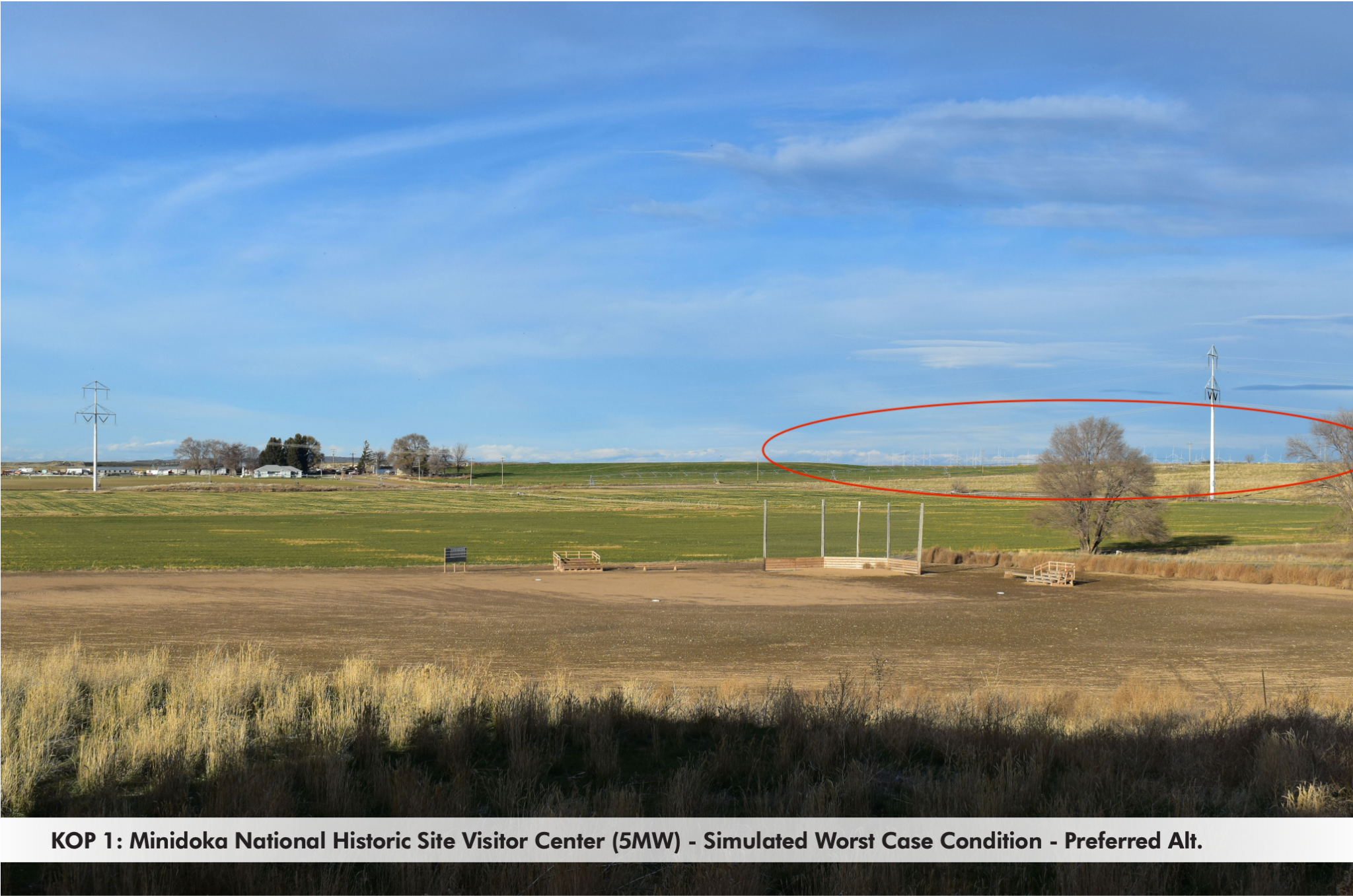
Section 106 is a procedural law: it requires agencies to consider effects on historic properties, but it does not require preservation, mitigation, or any other particular outcome. An overlarge APE adds delay, work, and expense — and even influences whether projects are proposed at all.
Within the APE, the agency must make a reasonable and good-faith effort to identify historic properties that may be affected.
A wider area can bring more properties, preservation offices, Tribes, local governments, and other consulting parties into the review.
More identification, eligibility decisions, effects analysis, and negotiation can increase cost, delay, and exposure to litigation.
Start with the acreage reported for direct review or survey, then compare the geographic reach of indirect or visual review and how the reviews ended.
The 67 projects whose documents state a direct APE, survey area, or development-area acreage.
Congress can make APE determinations more consistent and proportionate while preserving review of genuine effects on historic properties. Reform benefits clean energy projects most: gas and LNG review areas are already small, so setting maximum APE scope changes little for them. The gains from each reform below go overwhelmingly to wind, solar, and transmission projects.
Establish a bright-line limit on visual APEs — such as three miles — or direct the Advisory Council on Historic Preservation to adopt such a limit by regulation as they have done for tall FCC-permitted telecom infrastructure.
Treat a visual change as adverse only when it materially diminishes a documented characteristic that makes a property eligible for the National Register, measured against the property's existing setting.
Limit Section 106 effects to those directly, proximately, and causally attributable to the discrete federal undertaking, rather than cumulative or regional effects of independent actions.
Entire land- and seascapes — including the 500–600-square-mile Nantucket Sound — have been treated as single historic properties. Require parties to identify the specific character-defining features that make such a property eligible, and limit adverse-effect findings to material impairment of those features.
APE reform is one part of a broader Section 106 agenda. The full proposal also addresses deadlines, mitigation, litigation remedies, and SHPO/THPO capacity.
Read the full reform proposal →Below are the projects in our dataset whose public Section 106 or NEPA documents state an indirect or visual APE distance, ranked. Nearly all figures above 2 miles are for clean energy or transmission projects.
63 projects with a stated distance, in miles
Agencies aren't trying to burden clean energy in their NHPA administration. Because visual review is linked, by regulation, to how far a project can be seen (and clean-energy infrastructure is tall), a facially neutral rule produces much larger review areas for these projects.
A review system that scales with visibility exposes renewable energy generation and transmission to longer delays and greater litigation exposure. These are the projects a clean-energy buildout requires. Treating these projects fairly doesn't require ignoring all visual effects on historic properties. The question for Congress is whether the geographic scope and legal consequences of that consideration are clear, consistent, and proportionate to effects on actual historic properties.
Search the underlying project reviews. Download the data.
96 projects — search or filter by category
| Project | Type | Agency | Direct APE / survey | Indirect / visual APE | §106 outcome |
|---|
This pilot dataset covers 96 federal energy-project reviews, primarily from January 1, 2021 through June 27, 2026. It draws from FERC environmental reviews for gas and LNG projects; BOEM findings and agreements for offshore wind; and BLM agreements, treatment plans, and environmental reviews for wind, solar, and transmission projects.